

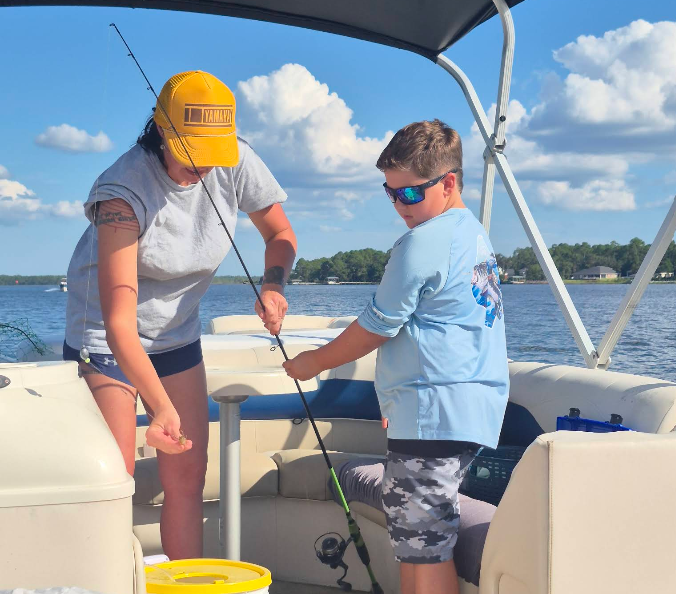
Preparing a child for a charter comes down to two decisions, and neither one involves tackle. Pick a trip short enough that the day ends before the mood does, and tell the child honestly what the morning will look like. Premium fishing charters are built around family groups across the Florida Panhandle, launching from Navarre Beach, Pensacola, Gulf Breeze, and Fort Walton Beach, and the boat is never shared with strangers.
Rods, reels, live bait, and Florida fishing licenses are included, so parents are not buying gear for a one-time trip. Everything else below is about the child, not the fishing.
Start with the trip length, not the fish
Parents almost always book too long. The instinct is understandable, since a half day feels like better value and nobody wants to pay for a trip that ends just as it gets good. What happens instead is that a seven-year-old peaks around ninety minutes and spends the back half of a four-hour charter asking how much longer, which is not a memory anyone wants.
Match the clock to the child rather than the itinerary. Children under ten generally do best with two hours on protected water, long enough to catch fish and short enough that nobody gets restless or burned. Kids around ten and up who can handle a long car ride without complaint usually manage three hours comfortably. Teenagers who want to fish can do four and often want more. When a family tells us the ages, we will say plainly if we think the trip they picked is longer than the child will enjoy, even when the shorter trip costs less. A rundown of kid-friendly fishing trips sets out how the options scale as children get older.
Talking a child through what the day looks like
Most of the anxiety in a first charter comes from not knowing what happens. Kids build a picture from cartoons and expect either constant action or a boat the size of a cruise ship, and neither version survives contact with a real morning on the water. A few minutes of honest description the night before removes almost all of it.
Walk them through the sequence. You will meet the captain at the ramp, put on a life jacket, ride out for a little while, and then fish. There will be stretches where nothing happens, and that is normal, not a sign the day is going badly. The captain will show you how to hold the rod and will tell you when to reel. Fish are slippery, and some of them have spines, so you let the captain handle them until he says otherwise. Children who hear this in advance tend to settle into the rhythm much faster than children who arrive expecting nonstop action.
It also helps to name the fish. Telling a kid they might catch a redfish, a speckled trout, a flounder or a sheepshead gives them something specific to hope for. Vague promises of a big catch set up disappointment that a named species does not.
What to pack for a kid on a charter boat
The gear is handled, so the packing list is short and mostly about sun and comfort. These five cover almost everything that matters.
- Sunscreen applied before you leave, plus the bottle for reapplying, since the reflection off the water doubles the exposure
- A hat with a brim and a strap, because a hat that blows off at speed is gone for good
- A light long-sleeve shirt, which protects better than sunscreen alone and keeps a child cooler than bare arms in July
- Closed-toe shoes with grip, never flip-flops, on decks that will be wet within the first hour
- Snacks and more water than seems reasonable, since hunger and dehydration end more kids’ trips than boredom does
Skip the toys, the extra tackle, and anything that cannot survive getting wet. Phones and tablets are a judgment call, though a child staring at a screen tends to miss the moment the rod goes down.
Not sure if your child will make it through a 2-hour or 3-hour trip?
Call or text Captain Bryant at
850-582-3474
,
and we’ll tell you honestly which length fits their age.
Sun, snacks, and the things that end trips early
Sunburn and low blood sugar are the two most common reasons a family trip goes sideways, and both are entirely preventable. Reapply sunscreen at the halfway point whether or not anyone asks, because children will not think of it and the breeze hides how hot they are getting. Keep water moving all morning rather than waiting for someone to say they are thirsty.
Motion sickness is the third, and it is far less of an issue on protected water than on the Gulf. Santa Rosa Sound and the bays behind Navarre Beach, Florida, stay calm in conditions that would make open water uncomfortable, which is a large part of why we put young children there. If your child gets carsick regularly, a non-drowsy tablet the night before and again in the morning is worth doing as a precaution. Tell us when you book, and we will factor it into where we take the group.
Thinking through which trip suits your family? Tell us the ages and how long you are in town, and we will recommend the length we would book for our own kids.
What happens on board and how we keep kids busy
A private boat changes the whole shape of a kids’ trip. Nobody is competing for the captain’s time, so the pace can flex around a six-year-old who needs help on every cast. Live bait does a lot of the work, since it draws bites without requiring a child to master a retrieve. Fishing around structure and grass edges keeps the action varied, and there is usually something to look at between fish, whether that is a dolphin working the channel or a heron on the shoreline.
The quiet stretches get filled with small jobs. Kids can help check the bait, watch the rod tips, and call out when something moves. Giving a child a role keeps them engaged in a way that handing them a rod does not. Our 2-hour kids fishing trip starting at $300 is built around exactly this, with a short run out and protected water the whole way.
Setting expectations about the catch
The last piece of preparation is the one parents skip. Fishing is not guaranteed, and a child who was promised a big fish will judge the whole morning against that promise. Frame it differently beforehand. The goal is to be on the water, to try, and to see what happens, with anything caught counted as a bonus rather than the point.
That framing tends to produce better days. Kids who are not measuring the trip against a number notice the ride, the birds, the bait in the livewell, and the feel of a rod loading up. When fish do come in, we clean and bag the catch at the dock so the family leaves with something for dinner, which lands better with a child than any photo. Groups fishing across generations run into the same dynamic, and our notes on multi-generational family trips get into how to keep a wide age range happy on one boat.
Get the trip length right, talk it through the night before, and pack for sun rather than for fishing. The rest takes care of itself once the boat leaves the ramp.
Send us your dates and the ages in your group whenever you’re ready to plan a trip out of Navarre, FL.
Call or text Captain Bryant at
850-582-3474
,
and we’ll tell you which length we’d book.
Related Topics: